You buy some beans. You take a look — the recommended resting period is one to two months, meaning you shouldn’t drink them for a month, and then you’ve got another month or two to finish them. Then you notice you’ve bought several bags of different varieties. So basically, the stuff is in your hands, but the roaster is telling you to wait a month or two before you even start. What kind of beverage comes with a “please don’t drink this yet” label? It’s like buying tea or wine and finding instructions that say, “Strongly recommend drinking after one month.” Once that month is up, every day you open the bag, pour out a few beans, and seal it back up. Before long, you realize the beans don’t taste as good anymore. Then they get worse and worse, until they’re downright unpleasant. And on top of that, you discover that the resting period varies from bean to bean, and the brewing parameters are different for each one too.
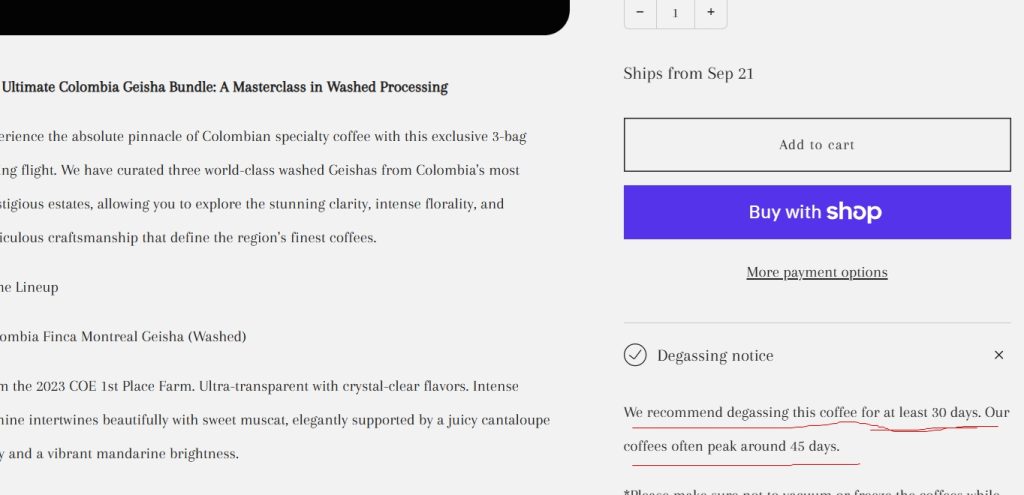
The resting period is a range, not a “best before” date. In other words, you buy it and it’s not even ready to drink yet.
Just get a feel for this “plea” from world coffee roasting champion George Captain:
Why are they begging you to rest your beans? Because the difference between rested and unrested beans is enormous. It’s not that you can’t drink them unrested — it’s just that they’re nowhere near as good, and can even be pretty rough. It’s also not that nobody likes them that way — there are indeed a rare few who genuinely prefer it. But that’s the exception, not the rule.
And it’s not just that. Different roasters and different roasting styles have different requirements — some say one or two weeks, some say dozens of days. Some demand even more:
Some resting periods are extremely long — two months, even.
Resting beans is an incredibly annoying characteristic and an incredibly annoying thing to deal with, because you buy them precisely because you want to drink them — and yet once they’re in your hands, you can’t. Not only can you not drink them, you have to wait this long, and by then who knows what kind of mood you’ll be in. So a lot of people, myself included, end up finishing many bags before the resting period is even up. Others rest them for a while, take a look, and realize — not even halfway through the recommended time. And you’re furious.
What’s more, even after resting for a month or two, the “peak flavor window” is just an ideal. In everyday brewing, you’re constantly opening and closing the bag, and the flavors fade even faster. You might not even get half of that peak window. Leave them sitting for fifty or sixty days, and the good-tasting period afterward might only last a dozen days or so. It’s maddening. That’s why both roasters and consumers have been forced to come up with all sorts of workarounds — single-dose packaging, single-dose freezing. The higher-end it gets, the more complicated it becomes.
Beyond the resting issue, you also notice that sometimes your brew tastes great, and sometimes it doesn’t. Sometimes you brew a cup, go do something else, and by the time you come back it’s gone cold and tastes worse. Same thing at cafés: sometimes it’s good, sometimes it’s not. This barista pulls a great shot, that one doesn’t. And many people — myself included — have had this experience: a café where you had one amazing cup, and never again. You taste an incredible bean today, think “I’ll get that next time,” and when next time comes, it’s not good anymore. And no matter how many times you go back after that, it never reaches that level again — it’s just mediocre.
I’ve had this happen countless times. In fact, the vast majority of cafés are like this. Once I went to a café with a friend in the coffee industry and ordered a Colombian Pink Bourbon. It was stunning. We couldn’t stop raving about it — we had no idea it could taste that good. So a few days later, we went back. It was completely ordinary. We tried it twice more after that — same thing, thoroughly mediocre. Same beans, same barista. It never came close to that first cup again.
Another time, I went to a café I know well and ordered a particular bean. I sat there waiting, chatting with the barista while he brewed. After he finished, he took a sip, frowned, and dumped the entire carafe. I asked what was wrong. He said it wasn’t brewed right, and started over. That’s actually the good scenario — plenty of cafés won’t dump a bad brew and remake it for the customer.
You order an expensive bean, expecting something wonderful, and it turns out worse than the cheapest options on the menu. That’s extremely common too.
Coffee is just that unpredictable.